
The Unexpected Wisdom of Career Day
There’s something deeply humbling about trying to explain your work to a room full of elementary school children. As a qualitative researcher and professional gerontologist, I spend much of my time thinking about stories, systems, lived experiences, and the ways people move through communities across the life course. But when my son’s school sent out their annual call for career day volunteers a few months ago, I found myself, for the second year in a row, asking a surprisingly difficult question: How do you explain qualitative research and gerontology to a six-year-old?
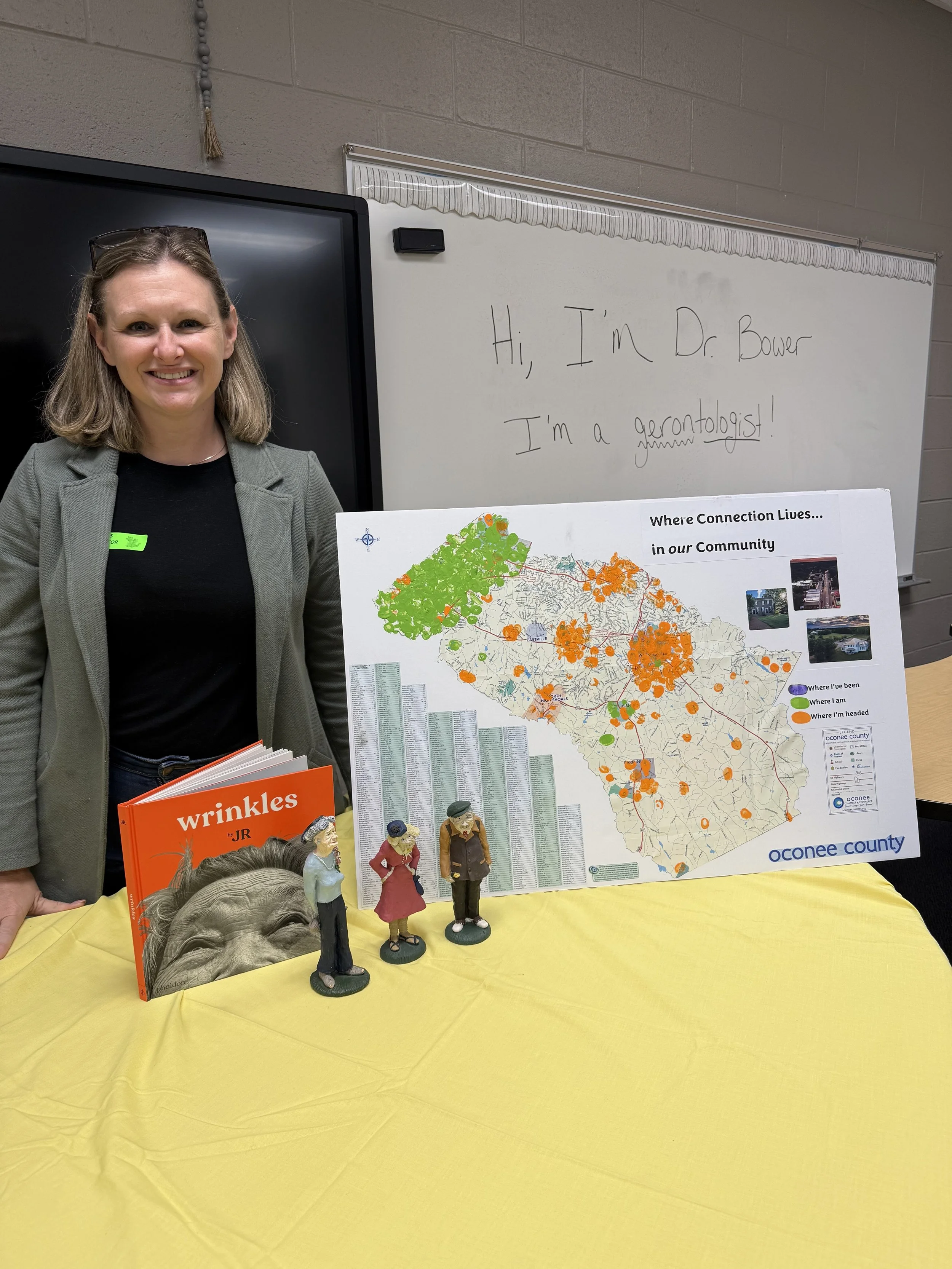
How do you explain qualitative research and gerontology to a six-year-old?
Should I bring examples of thematic coding? Show data visualizations? Read excerpts from an empirical article or book chapter? I already knew the answer from trying to explain “what mom does” to my own children over the years—usually met with polite confusion and quickly fading interest. Last year, I brought antique objects and talked about history, aging, and learning from older adults. I read Wrinkles and tried to explain that wrinkles are more than lines on a face; they are evidence of lived experience. It went okay. Not bad. Not great. Just… okay.
But something about it stayed with me.
When the volunteer request came around again this year, I knew I wanted to return. This time, though, I wanted it to mean something more. I didn’t want to simply talk to kids about aging or community. I wanted them to experience being part of something important.
As someone grounded in community-based and participatory research approaches, I often think about how people engage with ideas through doing, creating, and reflecting together. Arts-based methods are frequently used in qualitative and community research because they invite conversation in ways that feel accessible and relational. They allow people to participate rather than simply observe.
So, I decided to create a collaborative art project centered around social connection, aging, and community ecosystems.
I began simply.
I asked the students: “When does aging begin?”
The answers ranged from 18 to 40 years old before one student said what I had been hoping for: “At birth.”
Exactly.
From there, we talked about how people change throughout their lives. We crawl, walk, learn to read, discover new technologies, grow taller, grow older, and yes—eventually develop wrinkles. That was my cue to bring back Wrinkles. But this time, the story landed differently because it became a bridge rather than the centerpiece.
At the end of the book, the author shares stories about the older adults who participated in the project. I used that moment to remind the students that the older adults in their lives were once children, too. They were once nervous about school, excited about friendships, uncertain about the future, and learning how to navigate the world for the first time.
And with every stage of life, they gained something: experience, perspective, and wisdom.
But what mattered most to me was helping the children understand something we often forget in conversations about aging:
wisdom does not suddenly appear in old age. It accumulates over time, and even children possess forms of knowledge worth sharing.
The looks on their faces when I told them they had wisdom too were unforgettable.
So I gave them an example:
“What if a kindergartener were nervous about starting first grade? Could you help them feel less scared by sharing your experience?”
Immediately, the room shifted. Nods. Smiles. Recognition.
In that moment, they understood that their experiences mattered.
Wrinkles, Wisdom, and the Spaces Between Us
As a gerontologist, I often think about how societies devalue aging by disconnecting people from one another across generations. We treat aging as something that belongs only to older adults rather than something each one of us is actively experiencing every day. But intergenerational connection has the power to reshape that narrative. It reminds us that aging is not decline alone—it is growth, adaptation, memory, resilience, and accumulated understanding.
The following day, I brought the collaborative art project to a local senior center and shared my career day adventure with older adults there. Our conversation quickly expanded beyond the children’s activity and into something much deeper: visibility, belonging, and social connection.
Several older adults spoke openly about feeling invisible—as though their experiences, knowledge, and histories no longer held value in the communities around them. As a qualitative researcher, these moments are impossible to ignore because they reveal the emotional undercurrents beneath broader social structures. Loneliness and isolation are not simply individual experiences; they are reflections of how communities are designed, how relationships are sustained, and who feels seen within public life.
Community Is More Than Shared Space
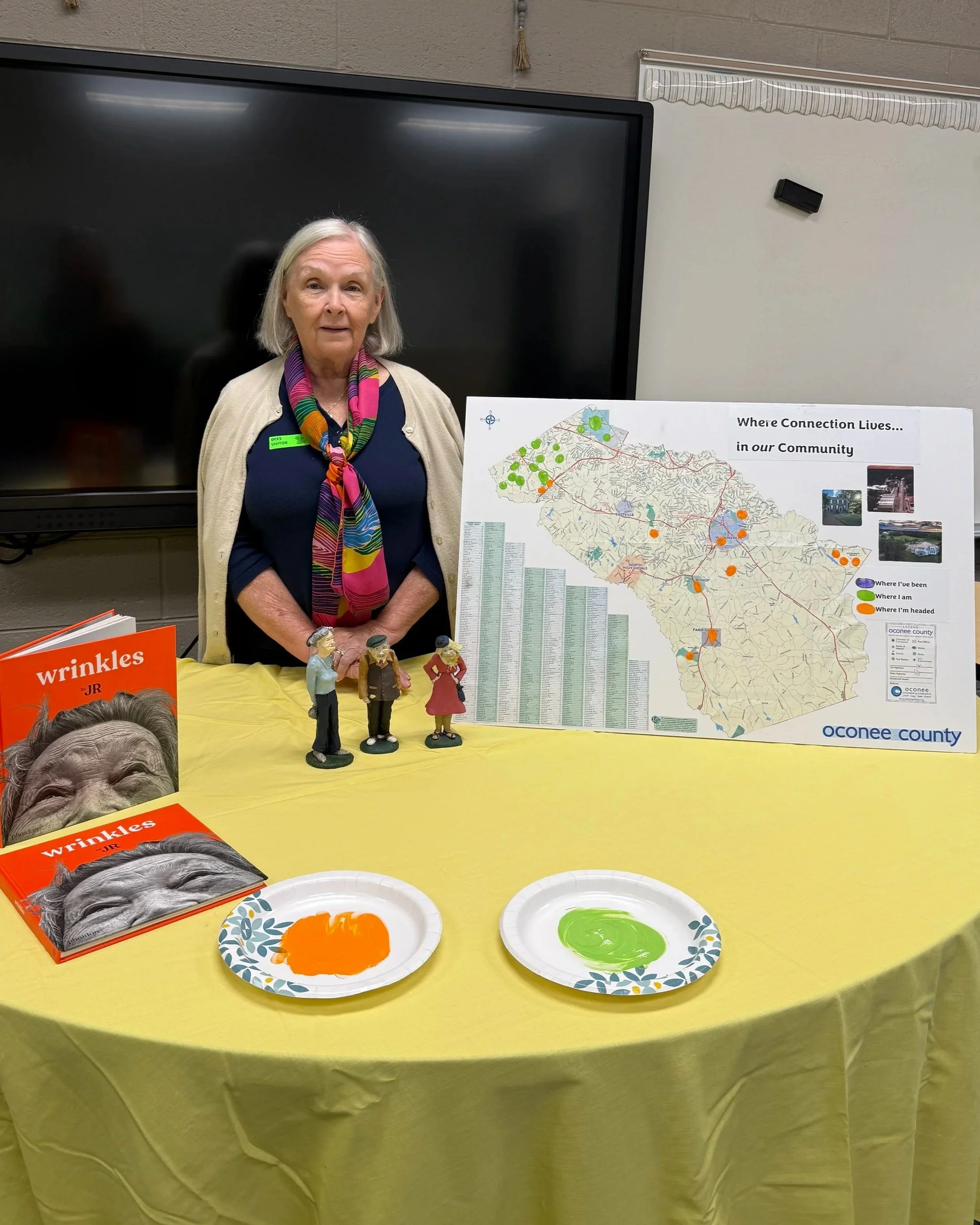
My mom, Kathleen.
A graphic design artist and a retired art teacher.
We spend much of our lives moving through spaces designed for productivity and consumption: sporting events, errands, appointments, restaurants, and obligations. But where are the spaces intentionally designed for connection? Where can people simply be together across generations without needing to purchase, achieve, or perform something?
Where are the spaces where people feel visible?
These are the kinds of questions that continue to shape my work as both a qualitative researcher and gerontologist. Community-based research is not just about collecting stories; it is about listening closely enough to understand how people experience belonging, exclusion, connection, and invisibility within the environments they inhabit.
Fingerprints on a Map
The collaborative project itself became part of that exploration.
I brought a large county map and asked each child and older adult to place fingerprints on it, representing where they had been (past), where they were now (present), and where they hoped to go someday (future). The participants studied the map carefully, asked questions about places in the community, and enthusiastically marked favorite destinations and meaningful spaces.
What emerged was far more than an art activity.
They were no longer passive listeners in a presentation about aging or research; they became active participants in imagining their role within the community ecosystem.
And this—this—is why intergenerational connection matters so much.
Not because one generation needs to “fix” another.
Not because anyone has all the answers.
But because older adults can help remind us what connection can look like. What it has looked like before. They remind us that relationships require maintenance, that communities can drift apart and still find their way back to one another. They remind us that signals can weaken and still be repaired.
And younger people help us understand something equally important: what it feels like when the environment itself makes connection harder. When the pace of life, the design of our communities, and the fragmentation of our social spaces create distance between people. When the chemistry just is not there.
What I heard from students and older adults were not separate conversations. They were reflections of the same underlying reality: people want to feel seen, valued, and connected to something larger than themselves.
And when those perspectives come together across generations, something important begins to happen…