
We All Take a Turn in the Middle: Rethinking the Sandwich Generation
I’ve been thinking a lot about the term sandwich generation.
You probably know the image. There are children on one side, aging parents on the other, and some exhausted middle-aged person squished between them packing lunches, scheduling doctor’s appointments, answering work emails, managing medications, driving someone somewhere, and trying to remember whether they ever moved the laundry from the washer to the dryer (aka, me. That’s me).
And, I understand why the metaphor works.
Sometimes caregiving really does feel like being squeezed.
But the gerontologist in me keeps getting stuck on another part of the phrase:
Why do we call it a generation?
A generation describes a group of people born or coming of age around the same time. But caring simultaneously for people who are younger and older than us isn't something that belongs to one particular generation.
It is a role we move through.
Maybe even a phase of the life course.
And if that's true, perhaps we need to rethink the sandwich.
We All Get a Turn in the Middle
Think about the sandwich metaphor literally for a moment.
At one point, we were the bread.
We began our lives needing other people to feed us, protect us, comfort us, advocate for us, and teach us how to navigate the world.
Someone else was in the middle doing the work of care.
Then, slowly, things changed.
We learned to feed ourselves. Make decisions. Drive places. Earn money. Solve problems. Care for our own needs.
And somewhere along the way, many of us began caring for someone else.
Maybe it was a child. Maybe it was a parent. Maybe it was a spouse, sibling, friend, neighbor, pet, or other loved one.
Suddenly, we were in the middle.
But here is what bothers me about the traditional sandwich metaphor: it makes that middle sound almost accidental. As though one day we wake up and discover we've been wedged between two groups of people who need things from us.
I'm not convinced caregiving happens that way.
We don't just turn into caregivers.
We have been learning how to care our entire lives.
Before We Give Care, We Experience It
Long before most of us become responsible for another person, we are watching.
We watch how the adults around us respond when someone is sick.
We learn whether asking for help is encouraged or discouraged.
We notice who cooks the meals, who makes the phone calls, who takes time off work, who remembers birthdays, who sits beside someone at the hospital, and who somehow always knows what everyone else needs.
We also notice who doesn't do those things.
Caregiving is shaped by our families, our communities, our cultures, our resources, and our individual values.
Some caregiving traditions we inherit. Some we adapt. Some we reject entirely.
I think about this often when we talk about intergenerational relationships. Knowledge doesn't simply move from a professional or institution into a family. So much of what we know about caring for another human being has been accumulated through observation, experience, storytelling, and relationships.
We learn how to care partly because, at some point, someone cared for us.
Maybe the Middle Isn't Being Squeezed
This is where the sandwich analogy starts to fall apart…. Or maybe it gets better.
Because without whatever is between those two pieces of bread—the cheese, lettuce, tomato, peanut butter, meat, or whatever else you're putting in there—you don't really have a sandwich.
You have toast.
The middle is what connects the pieces.
Yet when we talk about the sandwich generation, we tend to describe the middle almost entirely in terms of burden.
And make no mistake: caregiving can be exhausting. It can create financial strain, emotional stress, complicated family dynamics, impossible schedules, and difficult decisions.
We should not romanticize that.
But what if being in the middle also means something else?
What if the people in the middle are connectors between generations?
They carry information in both directions.
They translate.
They preserve family stories.
They negotiate changing roles.
They introduce children to grandparents and grandparents to new ways of understanding younger generations.
They carry traditions forward while deciding which traditions need to change.
The middle isn't simply absorbing pressure. It is also where an enormous amount of intergenerational exchange happens.
Care Doesn't Only Move in One Direction
There is another problem with the sandwich visualization.
It gives us the impression that the person in the middle is the caregiver while the people on either side are recipients.
Real life is much messier than that.
An older parent may need help getting to a medical appointment, but still be the person their adult child calls for advice.
A grandparent may need assistance managing technology while providing childcare several days a week.
A teenager may depend financially on their parents while becoming an important source of emotional support during a family crisis.
A person living with a disability may receive physical assistance while providing friendship, knowledge, humor, guidance, and care to everyone around them.
Giving care and receiving care are not mutually exclusive categories. Because most of us are doing both.
That makes me wonder whether interdependence is a much more useful idea than independence when we think about caregiving across the life course.
Eventually, We Become the Bread Again
There is another part of this metaphor we don't talk about very often.
If we are fortunate enough to live long lives, many of us will eventually move out of the middle.
Our capacity to do everything ourselves may change.
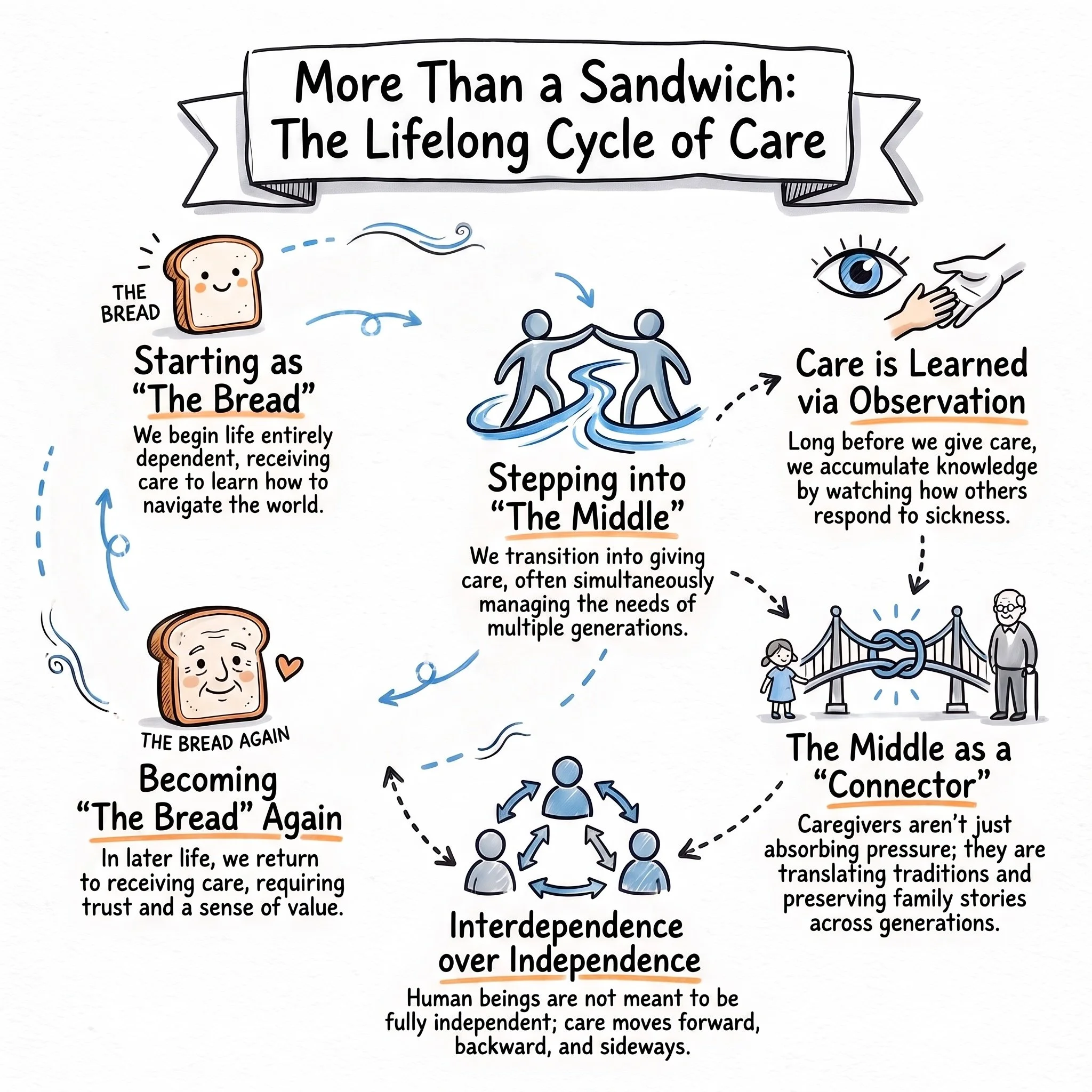
This image reclaims the "sandwich generation" metaphor, transforming a concept typically associated with stress into a profound observation of the human life cycle. Being caught between the needs of children and aging parents is not an isolated burden for one age group, but rather a dynamic phase of interdependence that almost everyone will eventually inhabit.
We may need help driving.
Managing medications.
Preparing food.
Navigating technology.
Recovering from an illness.
Making complicated decisions.
Or simply doing the countless small things that make everyday life work.
In other words, we may become the bread again.
For people who have spent decades being the person everyone else relies upon, that transition can be incredibly difficult.
There is vulnerability in saying:
I need the help now.
But maybe receiving care is not the opposite of caregiving.
Maybe it is another part of learning how to care.
Early in life, we receive care because we have little choice.
Later in life, receiving care can require something different: enough trust to allow another person to help us while still knowing that we have value, knowledge, agency, and something to contribute.
That matters.
Because needing care should never erase everything a person has become.
Perhaps, Care Is More of a Current Than a Sandwich?
I'm not sure I have the perfect replacement metaphor yet.
Maybe care is a current.
Maybe it is a cycle.
Maybe it is an ecosystem.
Maybe it is something we pass forward, backward, and sideways throughout our lives.
What I do know is that the sandwich generation feels too static for something that is constantly moving.
Our life begins with receiving care.
Over time, our need for certain kinds of care may wane while our capacity to provide care grows.
Then many of us spend years moving between roles—sometimes giving, sometimes receiving, and often doing both at exactly the same time.
And if we live long enough, we may eventually have to learn something many of us find surprisingly difficult:
how to receive care again.
Not because we have become less valuable.
Not because our contributions are finished.
But because human beings were never meant to move through an entire lifetime completely independent of one another.
Perhaps that is the part of caregiving we should be talking about more.
The goal isn't simply to survive our turn in the middle. It is to recognize that care moves between us across an entire lifetime.
At different moments, we hold someone else.
At different moments, someone holds us.
And maybe one of the most important things we can learn across the life course is how to do both.